How to Train for Your First HYROX Race in Warwick, RI
Sep 15, 2026
by Brad Lane
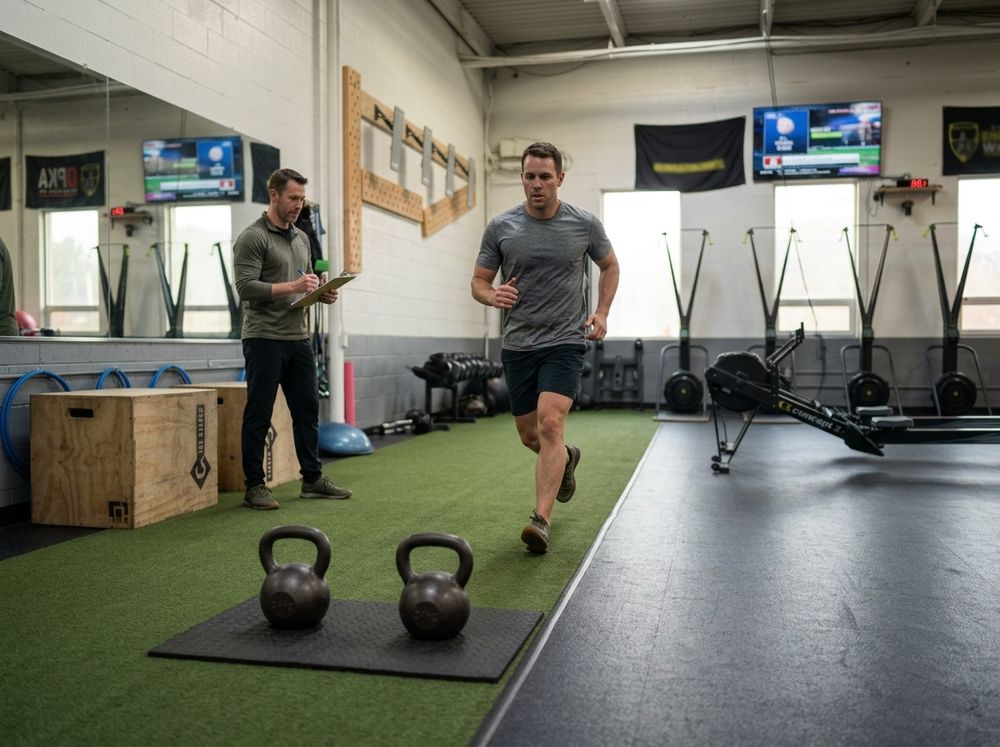
Signing up for your first HYROX can be exciting and a little intimidating. You may be comfortable running but unsure about sleds and wall balls. Or you may be strong in the gym but wonder how that strength will hold up once running is added between stations.
The most important thing to understand is this: preparing for HYROX requires more than getting stronger or becoming a better runner. You need to develop both qualities and practice using them together.
That is especially relevant for athletes in Rhode Island because It Starts Here Fitness in Warwick is Rhode Island’s first official HYROX affiliate. Its HYROX programming combines running, functional exercises, strength, endurance, and race-specific preparation.
Here is what first-time athletes should focus on before stepping onto the race floor.
🏃 First, Understand What HYROX Actually Demands
HYROX combines eight 1-kilometer runs with eight functional workout stations. You alternate between running and a station until you have completed the full event.
The stations include the SkiErg, sled push, sled pull, burpee broad jumps, rowing, farmers carry, sandbag lunges, and wall balls.
That format creates an important challenge.
You are rarely performing a movement while completely fresh.
Your legs may already be tired when you start pushing the sled. Your breathing may still be elevated when you reach the rower. Then you need to return to running after completing a demanding station.
This is why HYROX Training at It Starts Here Fitness incorporates both functional fitness and endurance work rather than treating them as separate goals.
Build Your Running Base Before Chasing Speed
Eight kilometers of total running is significant, especially when those kilometers are interrupted by demanding exercise stations.
A common mistake is focusing almost entirely on the exercises that look most intimidating while treating the running as something that will take care of itself.
Instead, build your running capacity gradually.
For a newer runner, that might initially mean comfortable running mixed with walking. Someone with more experience might incorporate easy runs and controlled intervals.
Your starting point matters more than copying another athlete’s mileage.
The CDC recommends that adults work toward at least 150 minutes of moderate-intensity aerobic activity each week, or an equivalent amount of vigorous activity, alongside muscle strengthening work on at least two days. These are general health guidelines rather than a HYROX race plan, but they illustrate why aerobic and strength work both belong in a balanced fitness routine.
💪 Build Strength You Can Repeat
HYROX does not simply ask whether you can move a weight once.
You need to produce force repeatedly while fatigue accumulates.
That makes movements such as squats, hinges, lunges, carries, pushes, and pulls useful foundations for preparation.
The American College of Sports Medicine’s updated resistance training guidance emphasizes consistency and tailoring training to the individual’s goals rather than unnecessarily complicated programming.
This matters for first-time HYROX athletes.
You do not need the most advanced workout possible. You need enough strength to perform the required movements efficiently, plus the ability to repeat that effort as the race progresses.
Athletes who need more individualized preparation can also use Private and Semi-Private Personal Training at It Starts Here Fitness, where the facility states that programming is customized according to fitness level, goals, and movement needs.
Learn the Stations Before Trying to Race Them
Going faster is not particularly useful if you are still learning how to move efficiently.
Become familiar with the movement demands first.
For example, learn how to position yourself during a sled push. Practice maintaining control during loaded carries. Become comfortable on the SkiErg and rower. Learn a repeatable rhythm for wall balls.
Technique becomes even more important when you are tired.
ISH offers dedicated HYROX Classes in Warwick and describes Foundational training as a way to develop baseline strength, endurance, aerobic capacity, agility, skills, confidence, and competency before progressing toward more race-specific work.
For a beginner, that progression makes much more sense than immediately attempting full race simulations every week.
🔥 Practice Running on Tired Legs
This is where HYROX preparation becomes different from simply combining a running program with strength workouts.
Eventually, you need experience transitioning between the two.
Consider the difference between these sessions:
| General Fitness Session | HYROX Specific Session |
|---|---|
| Run while fresh | Run after functional work |
| Strength movements with full recovery | Strength movements while managing fatigue |
| Exercises practiced individually | Movements combined strategically |
| Focus on one fitness quality | Practice switching between demands |
You do not need to reproduce an entire race every time you train.
A coach might instead use shorter combinations that allow you to practice transitions while controlling total fatigue.
For example, a hypothetical training block could combine a manageable run, a functional station, another run, and a second station.
The exact distance, resistance, repetitions, and rest should match the athlete rather than being copied blindly from race day.
A Realistic Example Training Week
There is no universal HYROX schedule. Your training history, current running ability, recovery, race date, and division all matter.
However, a hypothetical week for an active beginner might look something like this:
Monday: Strength and functional movement training
Tuesday: Comfortable aerobic running
Wednesday: Recovery or light activity
Thursday: HYROX-specific coached training
Friday: Rest or easy movement
Saturday: Longer aerobic session or controlled run and station combinations
Sunday: Recovery
This is an example, not an individualized prescription.
Research on concurrent training supports the broader idea that strength and endurance can be developed within the same overall program. A systematic review and meta-analysis involving healthy adults ages 50 to 73 found concurrent strength and endurance training improved strength, power, and cardiorespiratory endurance.
Your own schedule should reflect your goals and ability to recover.
Avoid These First Race Training Mistakes
Before adding more volume or intensity, use this quick checklist.
- Do not ignore running because you are already strong
- Do not neglect strength because you consider yourself a runner
- Do not turn every workout into a race simulation
- Do not increase running volume and strength intensity aggressively at the same time
- Do not wait until race day to learn unfamiliar stations
- Do not treat every training session as a test
- Do not copy an advanced athlete’s program without considering your own starting point
A productive training plan should prepare you for race day while still allowing you to recover between sessions.
How Do You Know If You Are Ready?
Race readiness is not determined by one workout.
Ask yourself:
- Can I maintain controlled running when I am moderately fatigued?
- Do I understand the technique required for each station?
- Can I pace myself instead of starting every session too aggressively?
- Have I practiced transitions between running and functional work?
- Can I recover adequately from my current weekly training?
- Do I know the rules and requirements for my chosen race division?
You do not need to feel like an elite athlete before your first event.
You do want enough preparation that the format feels familiar rather than completely unpredictable.
What If You Are Completely New to HYROX?
You can begin by developing the underlying qualities before worrying about race performance.
ISH currently offers HYROX Training in Warwick, RI, and identifies itself as Rhode Island’s first official HYROX affiliate. Its HYROX program includes Foundational, Power, Engine, and Complete training formats, addressing different components of race preparation.
That gives local athletes an opportunity to practice the demands of the sport in a coached environment rather than trying to recreate the race from social media clips.
If you are new to exercise altogether, have an injury, or have a medical condition that affects exercise, your starting point may need to be more individualized. Speak with an appropriate health professional when necessary and tell your coach about relevant limitations before increasing training demands.
Frequently Asked Questions
Do I need to be a runner before starting HYROX training?
No, but running is a major part of the event and deserves dedicated preparation. If you are new to running, start gradually rather than immediately attempting race distance.
Do I need to be very strong to try HYROX?
You need enough strength and movement competency for the demands of your chosen division, but HYROX preparation is not simply about maximal strength. Endurance, pacing, technique, and the ability to work under fatigue matter too.
Should beginners complete full HYROX simulations every week?
Not necessarily. Smaller combinations of running and functional stations can develop race-specific skills without requiring a full simulation every session. Your training load should match your experience and recovery.
Can strength training and endurance training be done in the same program?
Yes. Research supports concurrent strength and endurance training as a practical way to develop multiple aspects of fitness. The ideal structure depends on your goals, training experience, and recovery.
Where can I train for HYROX in Rhode Island?
It Starts Here Fitness is located at 380 Jefferson Boulevard in Warwick and identifies itself as Rhode Island’s first official HYROX affiliate. The facility offers dedicated HYROX classes and race-specific training.
Ready to Prepare for Your First HYROX?
Your first HYROX does not need to begin with a brutal simulation.
Start by understanding the race, developing your running base, building repeatable strength, learning the stations, and gradually practicing how those skills work together.
If you want to prepare in a coached environment, explore HYROX Training at It Starts Here Fitness in Warwick and learn how its dedicated HYROX classes can help you prepare for the demands of your first race.